
 Image 1 of 4
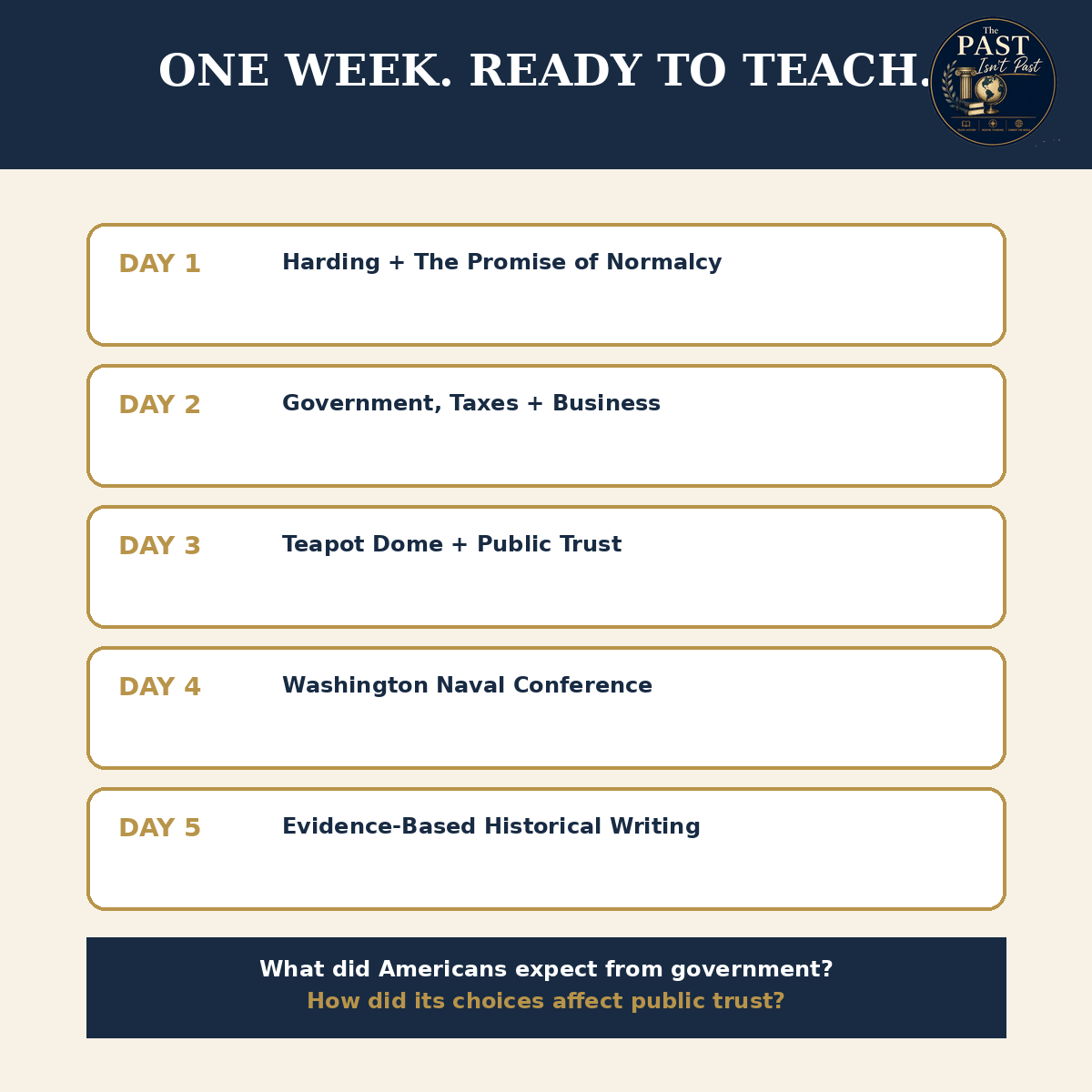 Image 2 of 4
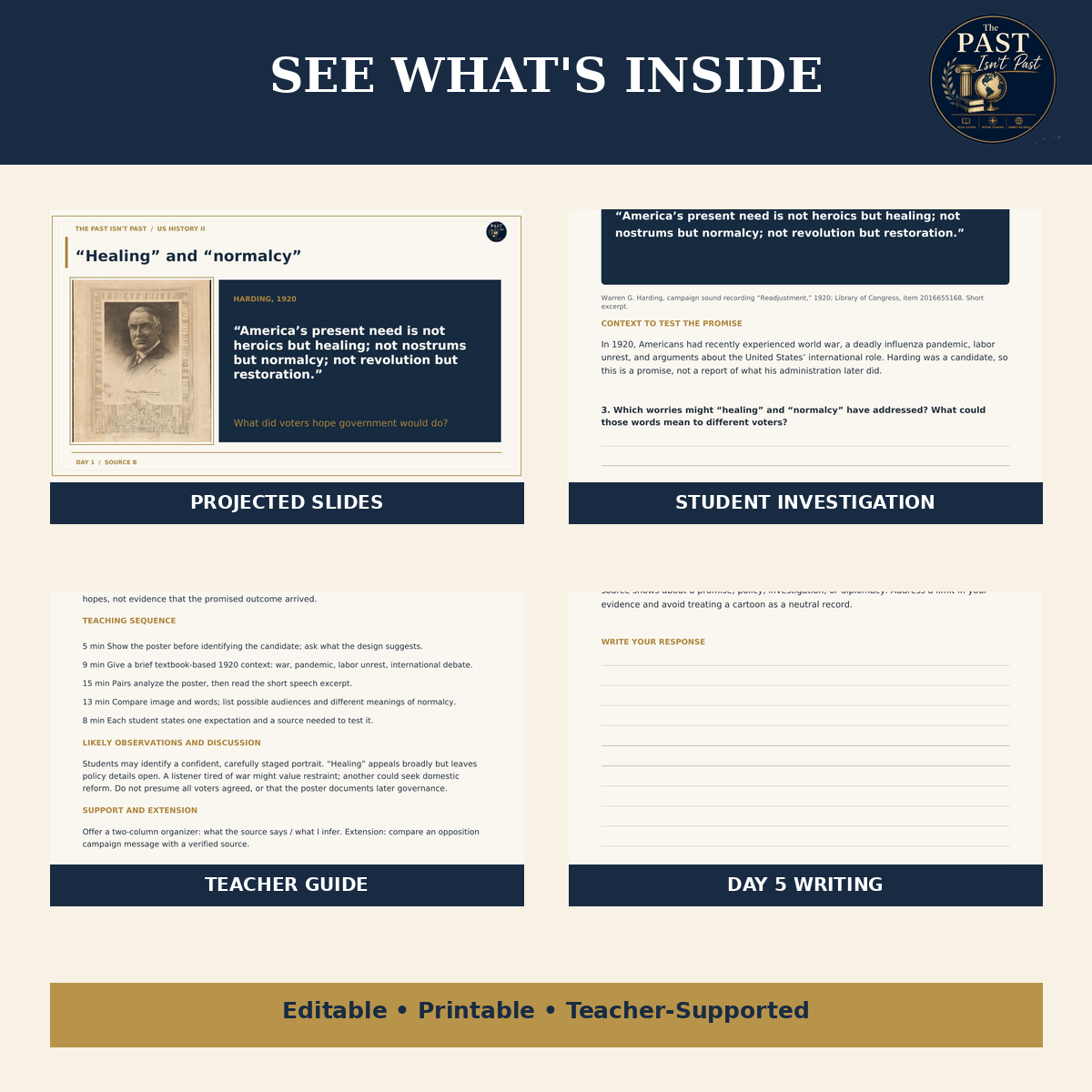 Image 3 of 4
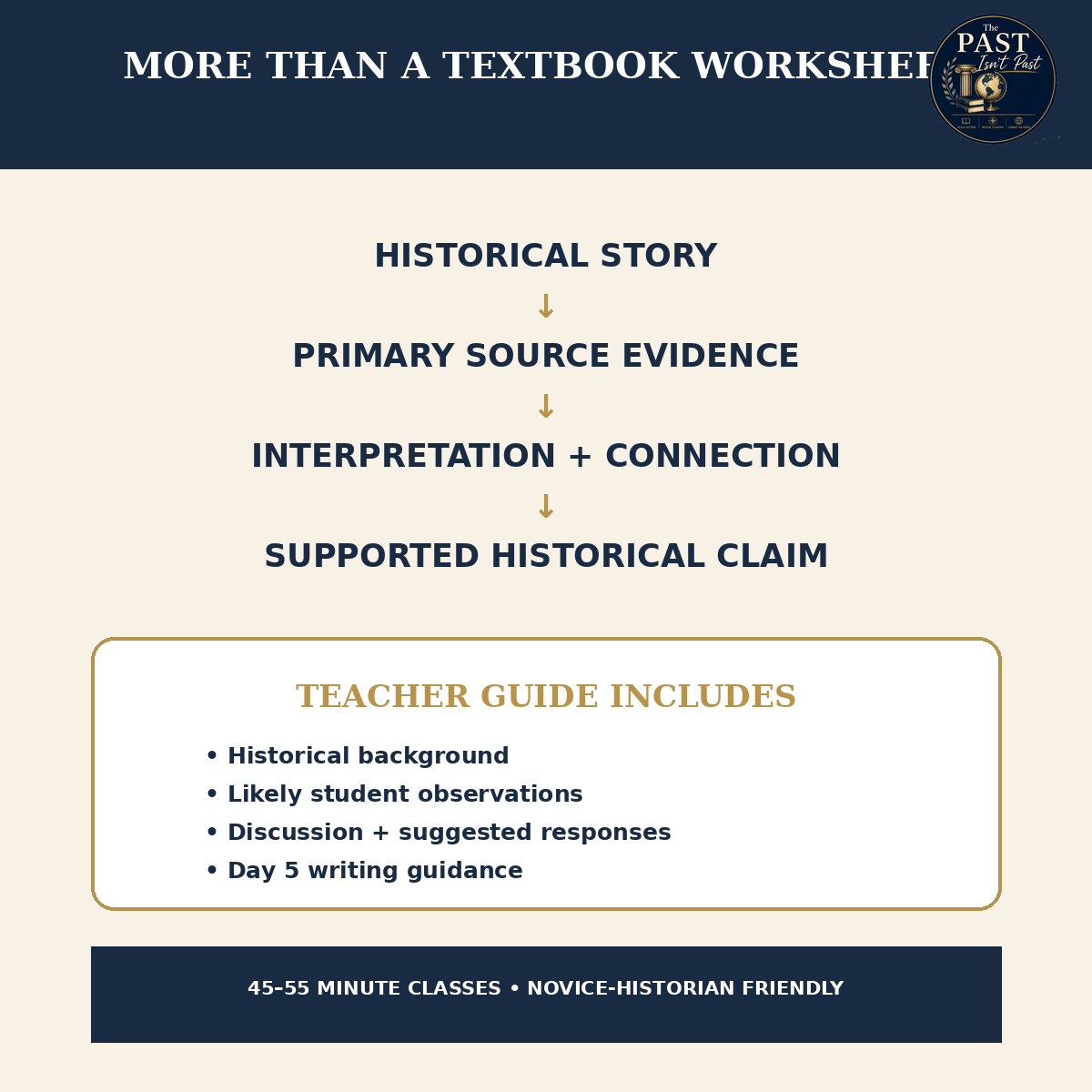 Image 4 of 4
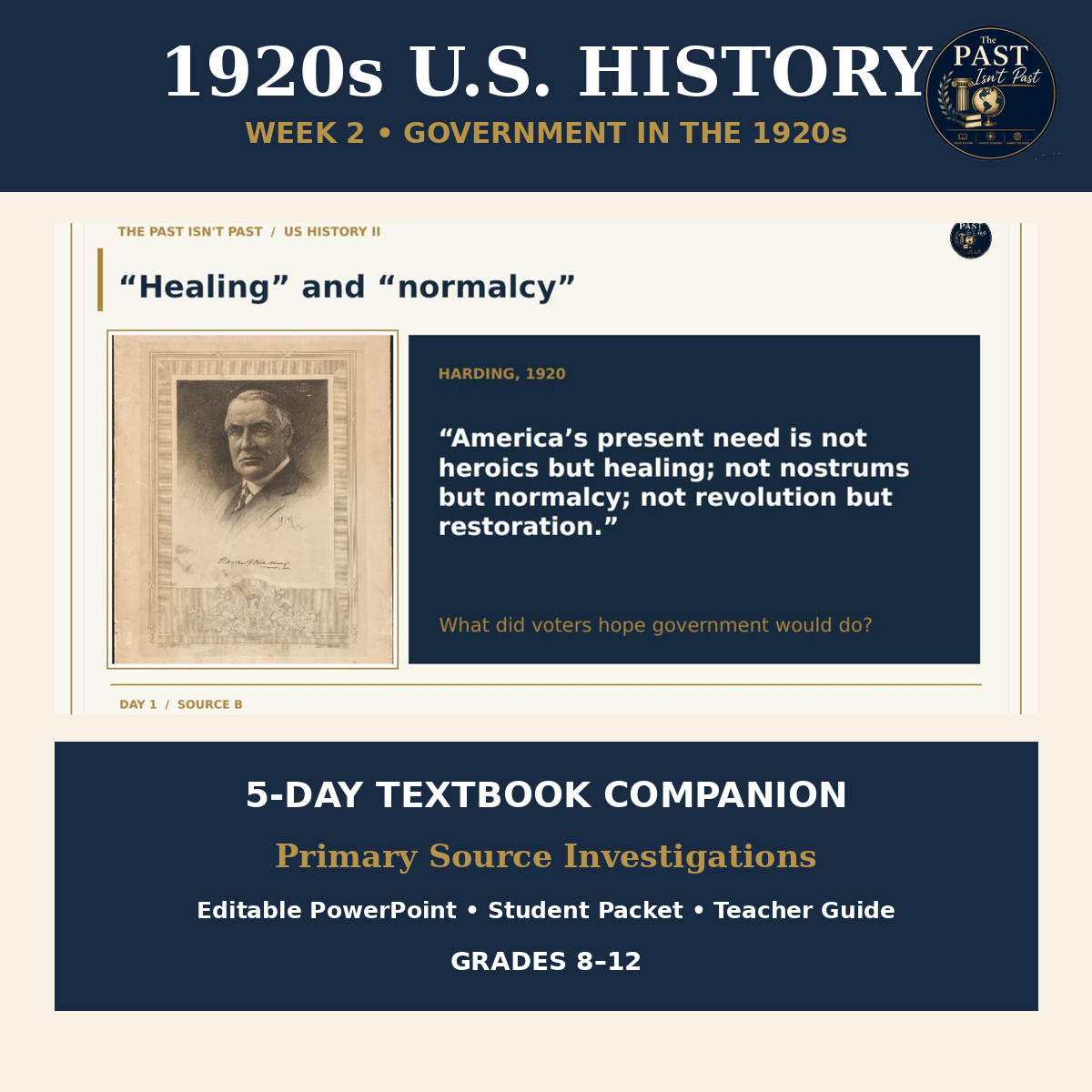
Turn your textbook’s coverage of government in the 1920s into a five-day historical investigation.
This ready-to-teach U.S. History companion asks students to investigate what Americans expected from their government after World War I and then examine what the federal government actually did. Using political imagery, speeches, photographs, government records, and other historical evidence, students explore Harding’s promise of “normalcy,” tax policy and business, the Teapot Dome scandal, and American diplomacy before constructing an evidence-based historical claim.
Essential Question:
What did Americans expect their government to do in the 1920s, and how did its choices affect public trust?
What Students Investigate
Day 1 — The Promise of Normalcy
Students examine Warren G. Harding’s 1920 campaign message and consider what “normalcy” promised Americans after war and upheaval.
Day 2 — Government and Business
Students investigate tax policy and the relationship between government and business, distinguishing between political arguments about taxation and evidence of actual government action.
Day 3 — Teapot Dome and Public Trust
Students examine the Teapot Dome scandal and consider how misconduct, investigation, and government accountability affected public trust.
Day 4 — The United States and the World
Students investigate the Washington Naval Conference and consider how the United States participated in international affairs during a decade often associated with “isolationism.”
Day 5 — Evidence-Based Historical Writing
Students return to evidence from across the week, compare government promises with government actions, and construct a supported response to the essential question.
What’s Included
✓ Editable classroom PowerPoint
✓ Projected-slides PDF
✓ Printable Student Investigation Packet
✓ Detailed Teacher Guide
✓ Primary-source and historical evidence activities
✓ Historical background and source context
✓ Suggested responses and likely student observations
✓ Discussion and differentiation guidance
✓ Evidence-based writing support
The Teacher Guide provides the historical background and instructional support teachers need to teach the investigations confidently without spending hours conducting additional research.
Because these are inquiry-based investigations, students may reach different conclusions when the evidence supports them. Rather than relying on a single rigid answer key, the Teacher Guide includes likely observations, suggested responses, source limitations, defensible interpretations, and guidance for evaluating students’ historical reasoning.
Designed for Real Classrooms
The week is designed around approximately 45–55 minute class periods and is centered on Grade 10 U.S. History, with flexibility for Grades 8–12.
Students move through a consistent historical-thinking process:
Historical Story → Question → Evidence → Interpretation → Claim
Use the investigations alongside your existing U.S. History textbook or curriculum. The textbook provides students with the foundation; these lessons put the historical evidence in their hands.
Need the complete 1920s unit?
This resource is also included in the 4-Week 1920s U.S. History Textbook Companion Bundle, covering the Postwar Economy, Government in the 1920s, an Unsettled Society, the Roaring Twenties, and the Harlem Renaissance.
Approximately 5 class periods | Grades 8–12 | Editable + Printable
Turn your textbook’s coverage of government in the 1920s into a five-day historical investigation.
This ready-to-teach U.S. History companion asks students to investigate what Americans expected from their government after World War I and then examine what the federal government actually did. Using political imagery, speeches, photographs, government records, and other historical evidence, students explore Harding’s promise of “normalcy,” tax policy and business, the Teapot Dome scandal, and American diplomacy before constructing an evidence-based historical claim.
Essential Question:
What did Americans expect their government to do in the 1920s, and how did its choices affect public trust?
What Students Investigate
Day 1 — The Promise of Normalcy
Students examine Warren G. Harding’s 1920 campaign message and consider what “normalcy” promised Americans after war and upheaval.
Day 2 — Government and Business
Students investigate tax policy and the relationship between government and business, distinguishing between political arguments about taxation and evidence of actual government action.
Day 3 — Teapot Dome and Public Trust
Students examine the Teapot Dome scandal and consider how misconduct, investigation, and government accountability affected public trust.
Day 4 — The United States and the World
Students investigate the Washington Naval Conference and consider how the United States participated in international affairs during a decade often associated with “isolationism.”
Day 5 — Evidence-Based Historical Writing
Students return to evidence from across the week, compare government promises with government actions, and construct a supported response to the essential question.
What’s Included
✓ Editable classroom PowerPoint
✓ Projected-slides PDF
✓ Printable Student Investigation Packet
✓ Detailed Teacher Guide
✓ Primary-source and historical evidence activities
✓ Historical background and source context
✓ Suggested responses and likely student observations
✓ Discussion and differentiation guidance
✓ Evidence-based writing support
The Teacher Guide provides the historical background and instructional support teachers need to teach the investigations confidently without spending hours conducting additional research.
Because these are inquiry-based investigations, students may reach different conclusions when the evidence supports them. Rather than relying on a single rigid answer key, the Teacher Guide includes likely observations, suggested responses, source limitations, defensible interpretations, and guidance for evaluating students’ historical reasoning.
Designed for Real Classrooms
The week is designed around approximately 45–55 minute class periods and is centered on Grade 10 U.S. History, with flexibility for Grades 8–12.
Students move through a consistent historical-thinking process:
Historical Story → Question → Evidence → Interpretation → Claim
Use the investigations alongside your existing U.S. History textbook or curriculum. The textbook provides students with the foundation; these lessons put the historical evidence in their hands.
Need the complete 1920s unit?
This resource is also included in the 4-Week 1920s U.S. History Textbook Companion Bundle, covering the Postwar Economy, Government in the 1920s, an Unsettled Society, the Roaring Twenties, and the Harlem Renaissance.
Approximately 5 class periods | Grades 8–12 | Editable + Printable