
 Image 1 of 3
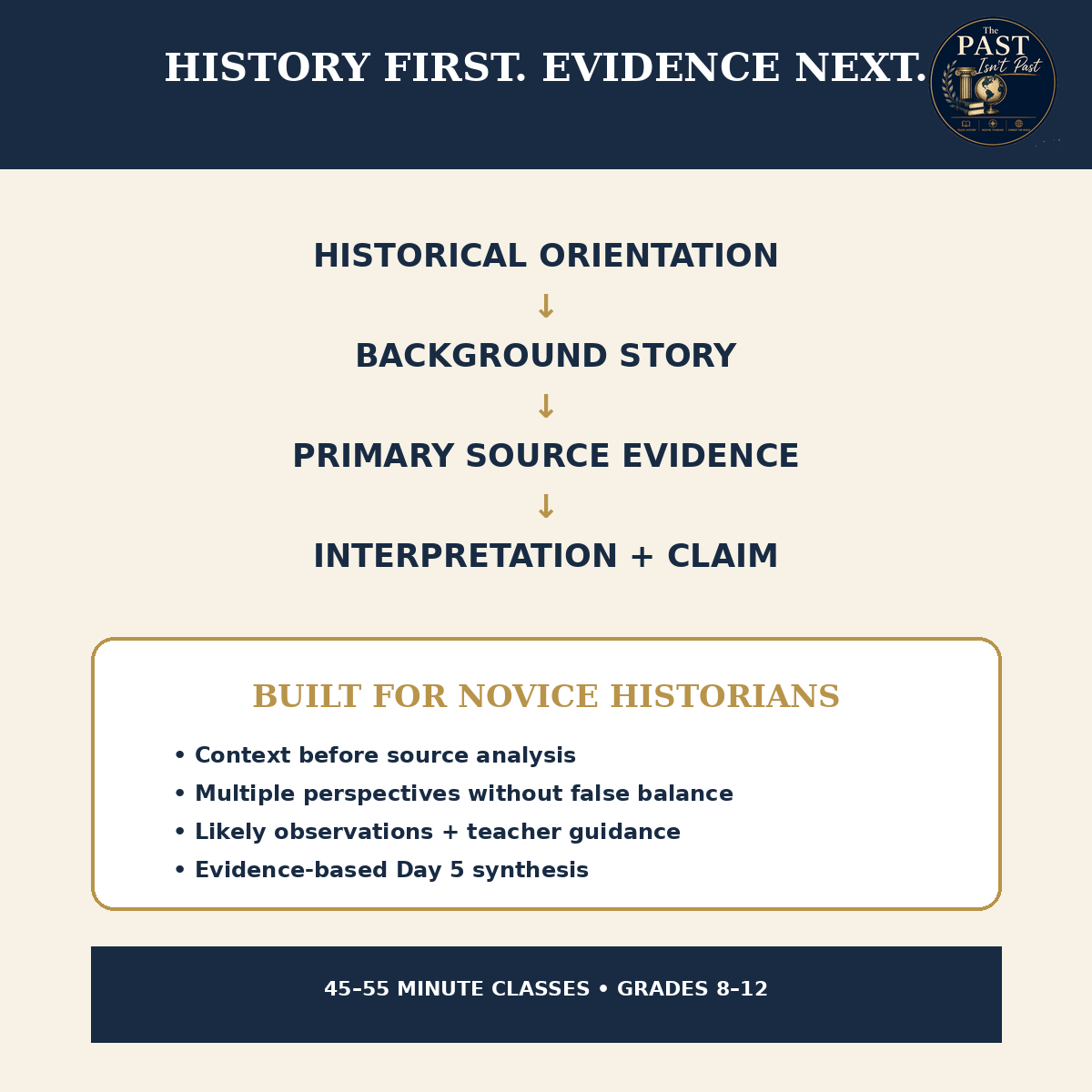 Image 2 of 3
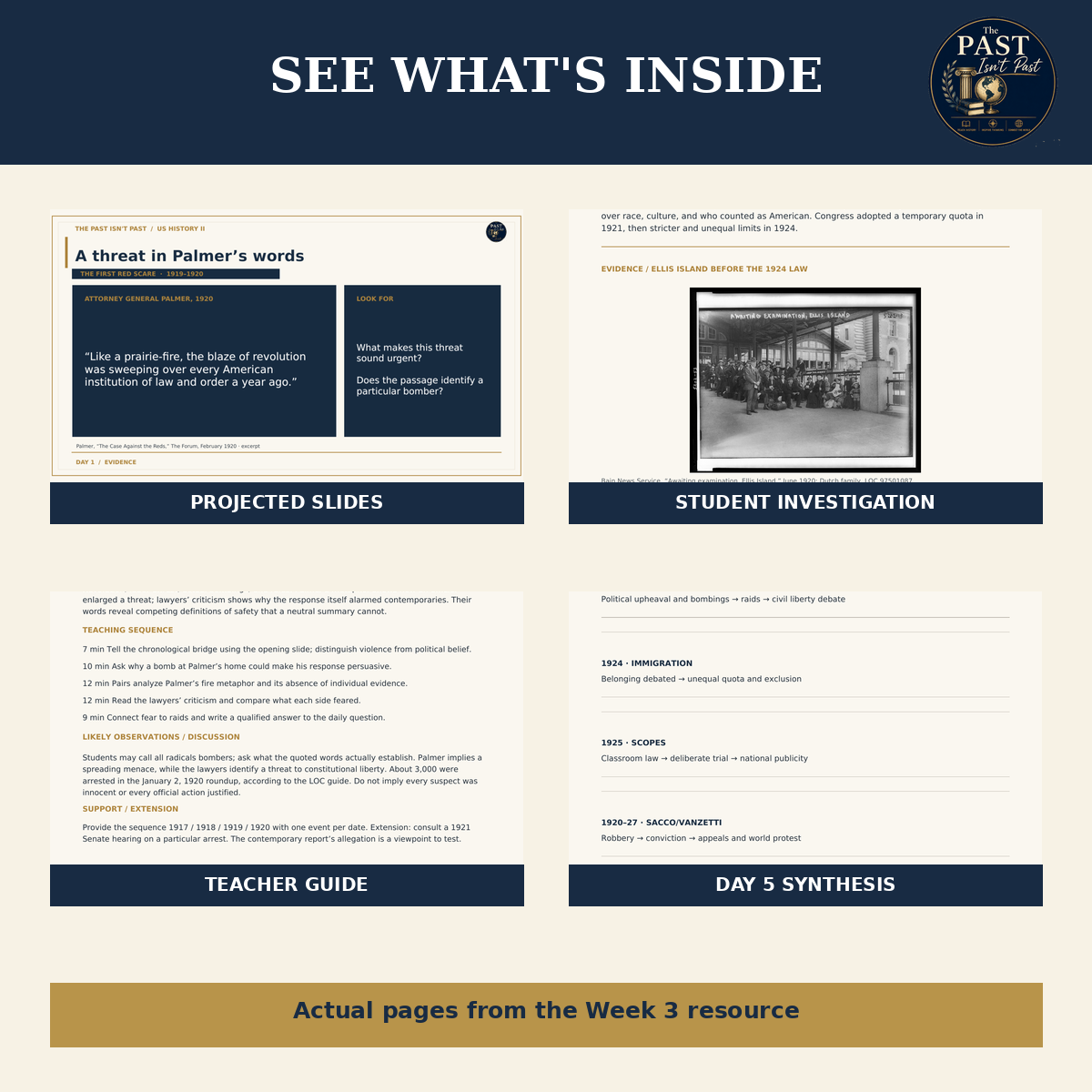 Image 3 of 3
The 1920s Week 3: An Unsettled Society | US History II
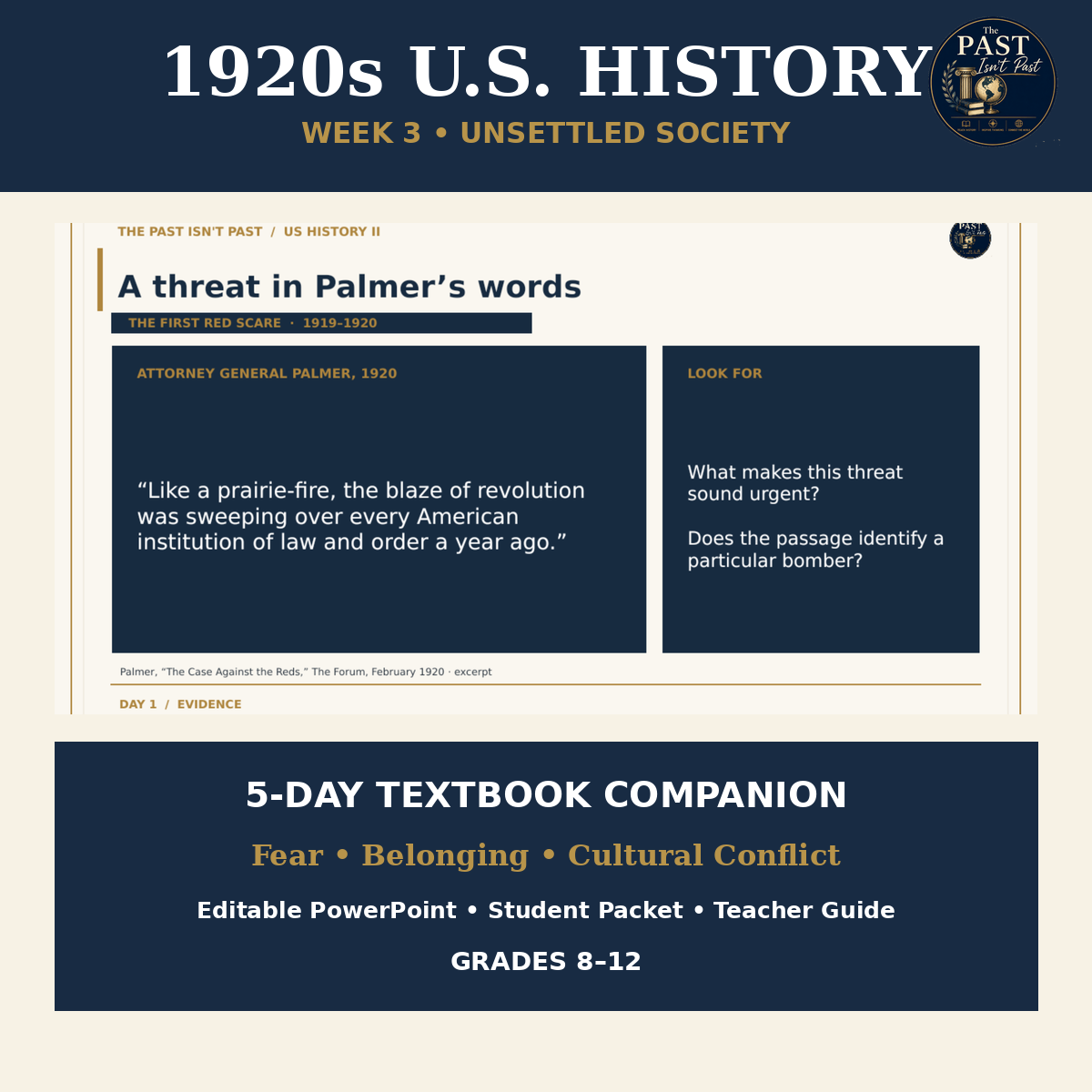
The 1920s were not simply “roaring.” They were also a decade of fear, conflict, rapid change, and difficult questions about who belonged in America.
Turn your textbook’s coverage of the unsettled society of the 1920s into a five-day historical investigation.
In this ready-to-teach U.S. History companion, students receive the historical background they need before working with primary sources and other historical evidence. Across the week, they investigate the First Red Scare, immigration restriction and exclusion, the Scopes Trial, and the Sacco and Vanzetti case to consider why political, demographic, and cultural change felt threatening to some Americans.
Rather than asking students simply to identify what happened, the investigations ask them to examine how fear shaped American responses to change and what those responses meant for individuals, communities, and ideas about belonging.
Essential Question:
Why did some Americans see the changes of the 1920s as threatening?
What Students Investigate
Day 1 — The First Red Scare
Students begin with the upheaval following World War I and investigate how revolution, labor unrest, anarchist violence, immigration, and fear of radicalism contributed to the First Red Scare. Evidence helps students distinguish between real events and the broader climate of fear that followed.
Day 2 — Immigration Restriction and Exclusion
Students examine growing nativism and the movement toward immigration restriction, including the 1924 immigration law. They investigate how ideas about nationality, race, culture, and “Americanism” shaped arguments over who should be allowed to enter and belong in the United States.
Day 3 — The Scopes Trial
Students investigate how a Tennessee classroom became the center of a national debate. Historical background and evidence help students move beyond a simple “science versus religion” interpretation to consider public education, law, cultural authority, modernity, tradition, and the role of the national media.
Day 4 — Sacco and Vanzetti
Students examine the controversial case of Nicola Sacco and Bartolomeo Vanzetti in the context of immigration, anarchism, the Red Scare, and questions about fairness in the American justice system. Students investigate why the case generated such intense debate without being directed toward a predetermined verdict about guilt or innocence.
Day 5 — Evidence-Based Synthesis
Students return to evidence from across the week, compare cases, identify patterns, and construct a supported historical explanation of why change created fear and how Americans responded.
What’s Included
✓ Editable classroom PowerPoint
✓ Projected-slides PDF
✓ Printable Student Investigation Packet
✓ Detailed Teacher Guide
✓ Primary-source and historical evidence activities
✓ Student-friendly historical background and orientation
✓ Source context and analysis questions
✓ Suggested responses and likely student observations
✓ Discussion and differentiation guidance
✓ Evidence-based synthesis and writing support
History First. Evidence Next.
These investigations are designed for students who may be encountering these events for the first time.
Students are not expected to somehow discover the basic history from an unfamiliar document. Instead, each investigation provides enough historical orientation for the evidence to make sense. Students can then use that evidence to go deeper: to question, connect, interpret, compare, and construct historical claims.
The Teacher Guide provides additional historical background so teachers can approach complicated topics confidently without spending hours conducting their own research.
Because these are inquiry-based investigations, many questions allow more than one defensible response. Rather than a rigid answer key, the Teacher Guide provides likely student observations, suggested responses, source limitations, discussion guidance, defensible interpretations, and support for the final synthesis.
Designed for Real Classrooms
The week is designed around approximately 45–55 minute class periods and is centered on Grade 10 U.S. History, with flexibility for Grades 8–12.
Students move through a scaffolded historical-thinking process:
Historical Orientation → Background Story → Question → Evidence → Interpretation → Connection → Claim
Use the investigations alongside your existing U.S. History textbook or curriculum.
Your textbook provides the foundation. This companion puts the evidence in students’ hands.
Need the complete 1920s unit?
Week 3 is also included in the 4-Week 1920s U.S. History Textbook Companion Bundle, covering the Postwar Economy, Government in the 1920s, an Unsettled Society, the Roaring Twenties, and the Harlem Renaissance.
Approximately 5 class periods | Grades 8–12 | Editable + Printable
The 1920s were not simply “roaring.” They were also a decade of fear, conflict, rapid change, and difficult questions about who belonged in America.
Turn your textbook’s coverage of the unsettled society of the 1920s into a five-day historical investigation.
In this ready-to-teach U.S. History companion, students receive the historical background they need before working with primary sources and other historical evidence. Across the week, they investigate the First Red Scare, immigration restriction and exclusion, the Scopes Trial, and the Sacco and Vanzetti case to consider why political, demographic, and cultural change felt threatening to some Americans.
Rather than asking students simply to identify what happened, the investigations ask them to examine how fear shaped American responses to change and what those responses meant for individuals, communities, and ideas about belonging.
Essential Question:
Why did some Americans see the changes of the 1920s as threatening?
What Students Investigate
Day 1 — The First Red Scare
Students begin with the upheaval following World War I and investigate how revolution, labor unrest, anarchist violence, immigration, and fear of radicalism contributed to the First Red Scare. Evidence helps students distinguish between real events and the broader climate of fear that followed.
Day 2 — Immigration Restriction and Exclusion
Students examine growing nativism and the movement toward immigration restriction, including the 1924 immigration law. They investigate how ideas about nationality, race, culture, and “Americanism” shaped arguments over who should be allowed to enter and belong in the United States.
Day 3 — The Scopes Trial
Students investigate how a Tennessee classroom became the center of a national debate. Historical background and evidence help students move beyond a simple “science versus religion” interpretation to consider public education, law, cultural authority, modernity, tradition, and the role of the national media.
Day 4 — Sacco and Vanzetti
Students examine the controversial case of Nicola Sacco and Bartolomeo Vanzetti in the context of immigration, anarchism, the Red Scare, and questions about fairness in the American justice system. Students investigate why the case generated such intense debate without being directed toward a predetermined verdict about guilt or innocence.
Day 5 — Evidence-Based Synthesis
Students return to evidence from across the week, compare cases, identify patterns, and construct a supported historical explanation of why change created fear and how Americans responded.
What’s Included
✓ Editable classroom PowerPoint
✓ Projected-slides PDF
✓ Printable Student Investigation Packet
✓ Detailed Teacher Guide
✓ Primary-source and historical evidence activities
✓ Student-friendly historical background and orientation
✓ Source context and analysis questions
✓ Suggested responses and likely student observations
✓ Discussion and differentiation guidance
✓ Evidence-based synthesis and writing support
History First. Evidence Next.
These investigations are designed for students who may be encountering these events for the first time.
Students are not expected to somehow discover the basic history from an unfamiliar document. Instead, each investigation provides enough historical orientation for the evidence to make sense. Students can then use that evidence to go deeper: to question, connect, interpret, compare, and construct historical claims.
The Teacher Guide provides additional historical background so teachers can approach complicated topics confidently without spending hours conducting their own research.
Because these are inquiry-based investigations, many questions allow more than one defensible response. Rather than a rigid answer key, the Teacher Guide provides likely student observations, suggested responses, source limitations, discussion guidance, defensible interpretations, and support for the final synthesis.
Designed for Real Classrooms
The week is designed around approximately 45–55 minute class periods and is centered on Grade 10 U.S. History, with flexibility for Grades 8–12.
Students move through a scaffolded historical-thinking process:
Historical Orientation → Background Story → Question → Evidence → Interpretation → Connection → Claim
Use the investigations alongside your existing U.S. History textbook or curriculum.
Your textbook provides the foundation. This companion puts the evidence in students’ hands.
Need the complete 1920s unit?
Week 3 is also included in the 4-Week 1920s U.S. History Textbook Companion Bundle, covering the Postwar Economy, Government in the 1920s, an Unsettled Society, the Roaring Twenties, and the Harlem Renaissance.
Approximately 5 class periods | Grades 8–12 | Editable + Printable