
 Image 1 of 4
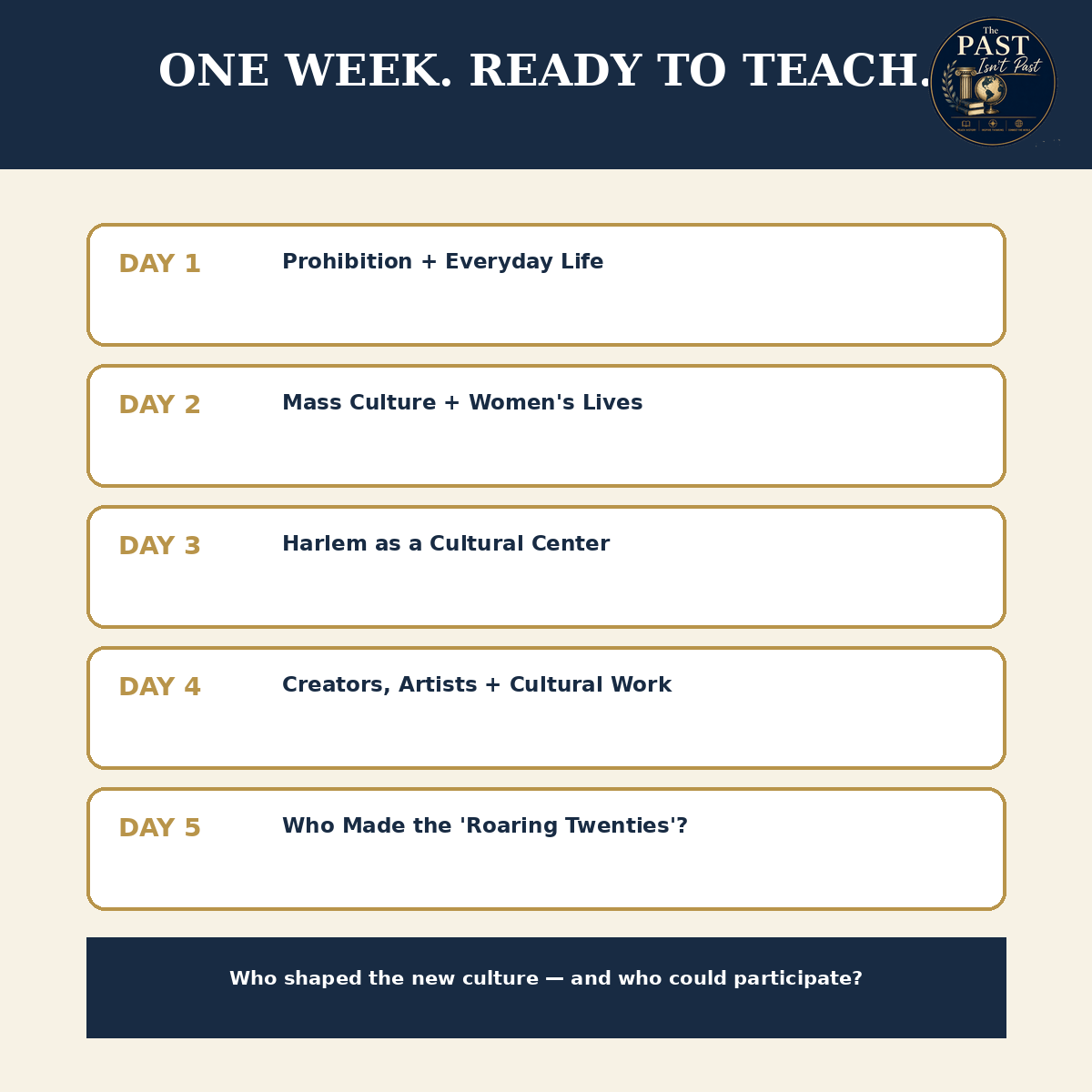 Image 2 of 4
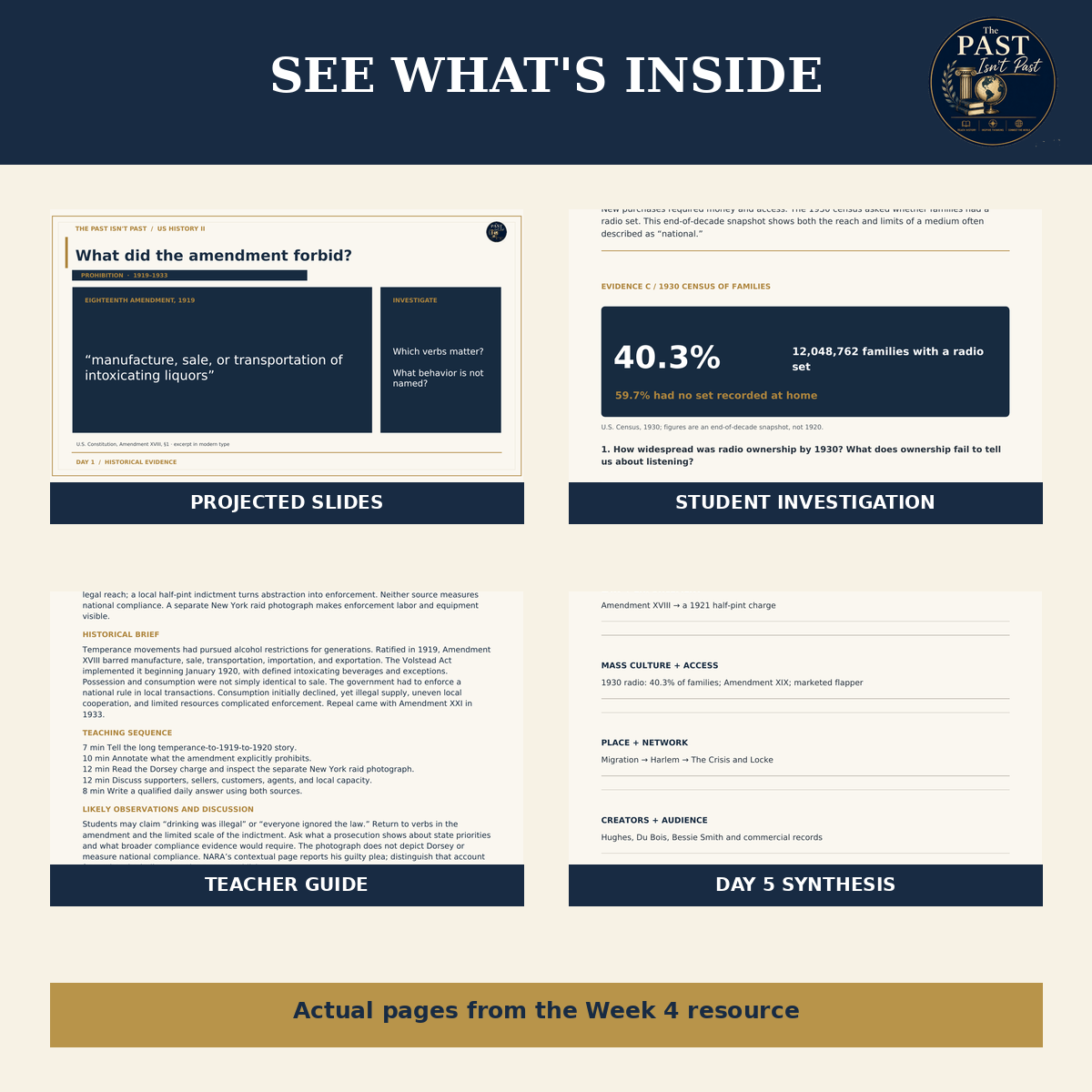 Image 3 of 4
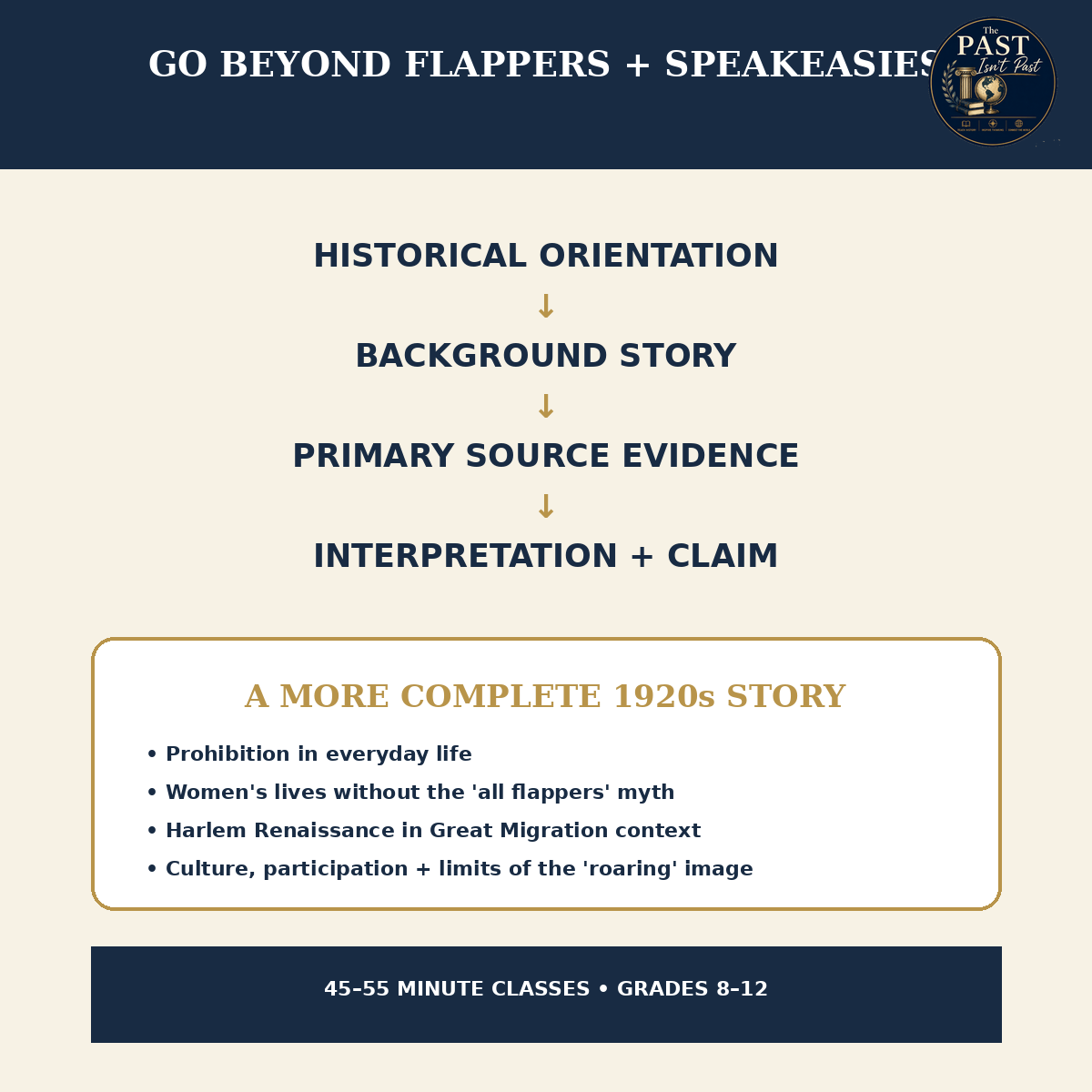 Image 4 of 4
The 1920s Week 4: Roaring Twenties & Harlem Renaissance | US History II
Roaring Twenties & Harlem Renaissance | Prohibition, Women, Music & Culture
The 1920s are often remembered through familiar images: speakeasies, flappers, jazz, automobiles, movies, and crowded dance halls. But who actually created the culture we now call the “Roaring Twenties”? And did everyone experience the decade in the same way?
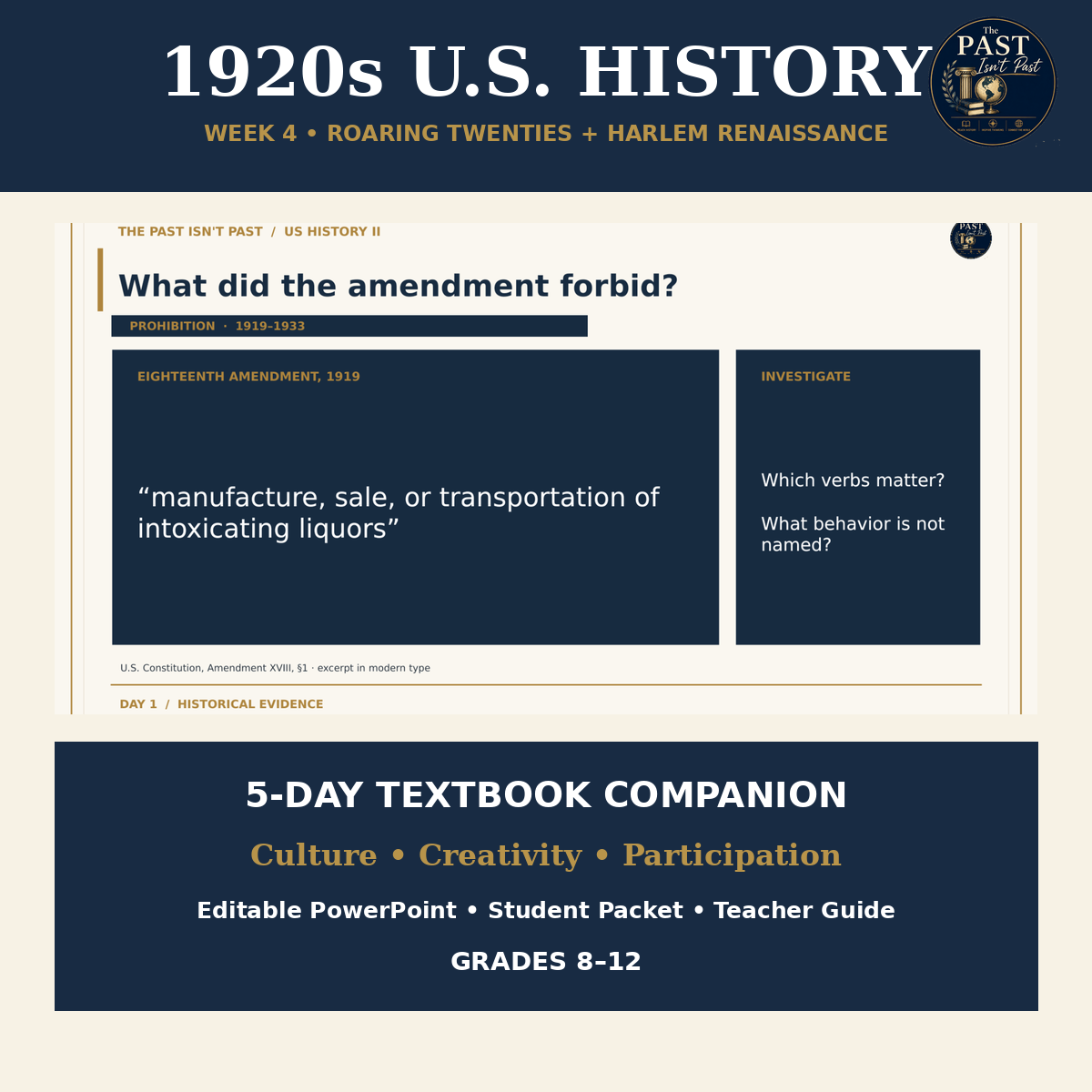
Turn your textbook’s coverage of the Roaring Twenties and Harlem Renaissance into a five-day historical investigation.
In this ready-to-teach U.S. History companion, students receive the historical background they need and then work with primary sources and other historical evidence to investigate Prohibition, mass culture, changing expectations for women, Harlem, Black cultural achievement, and the artists and creators who helped reshape American culture.
Throughout the week, students return to a larger question: Who participated in the cultural changes of the 1920s, who helped create them, and whose experiences complicate the familiar image of a decade that was “roaring” for everyone?
Essential Question
Who shaped the new culture of the 1920s, and who could participate in it?
What Students Investigate
Day 1 — Prohibition and Everyday Life
Students investigate what happened when the United States attempted to prohibit the manufacture and sale of alcoholic beverages. Rather than treating Prohibition simply as a story of speakeasies and organized crime, students examine the law, enforcement, public behavior, and evidence of how Americans experienced Prohibition in everyday life.
Day 2 — Mass Culture and Women’s Lives
Students explore the growth of mass culture and changing expectations surrounding women during the 1920s. Evidence helps students investigate changing fashions, leisure, consumer culture, media, and public life while avoiding the misleading idea that every American woman suddenly became a “flapper.”
Day 3 — Harlem as a Cultural Center
Students investigate why Harlem became an important center of Black cultural and intellectual life during the 1920s. Historical context connects the growth of Harlem to the Great Migration and helps students understand the people and communities behind what became known as the Harlem Renaissance.
Day 4 — Creators, Artists, and Cultural Work
Students turn their attention to the writers, musicians, artists, performers, and other creators who helped shape the decade. Rather than encountering the Harlem Renaissance simply as a list of famous names, students examine cultural work as historical evidence and consider what these creators communicated about Black life, identity, opportunity, and America.
Day 5 — Who Really Made the “Roaring Twenties”?
Students return to evidence from across the week and reconsider the familiar image of the decade. They identify who helped create and spread the new culture, consider who could participate in it, and use evidence to construct a supported historical claim about the meaning and limits of the term “Roaring Twenties.”
What’s Included
✓ Editable classroom PowerPoint
✓ Projected-slides PDF
✓ Printable Student Investigation Packet
✓ Detailed Teacher Guide
✓ Primary-source and historical evidence activities
✓ Student-friendly historical background and orientation
✓ Source context and analysis questions
✓ Suggested responses and likely student observations
✓ Discussion and differentiation guidance
✓ Evidence-based synthesis and writing support
Go Beyond the Familiar Images of the 1920s
Students often enter this unit already recognizing the imagery of the decade: jazz, flappers, speakeasies, radios, movies, and Harlem.
This investigation asks them to go further.
Students receive enough historical background to understand what was happening and why it mattered before they are asked to analyze unfamiliar evidence. They then use that evidence to investigate the people behind the cultural changes of the decade and to consider how experiences differed according to race, gender, class, geography, and opportunity.
The goal is not simply to tell students that the 1920s were complicated. The evidence allows them to discover that complexity themselves.
Teacher Support for Inquiry-Based History
The Teacher Guide provides additional historical background, source context, likely student observations, suggested responses, discussion guidance, and support for the final evidence-based synthesis.
Because these are inquiry-based investigations, many questions allow more than one defensible response. Rather than a rigid answer key, the Teacher Guide helps teachers recognize historically supported interpretations and guide students toward claims grounded in evidence.
Designed for Real Classrooms
The week is designed around approximately 45–55 minute class periods and is centered on Grade 10 U.S. History, with flexibility for Grades 8–12.
Students move through a scaffolded historical-thinking process:
Historical Orientation → Background Story → Question → Evidence → Interpretation → Connection → Claim
Use the investigations alongside your existing U.S. History textbook or curriculum.
Your textbook provides the foundation. This companion puts the evidence in students’ hands.
Need the Complete 1920s Unit?
Week 4 is also included in the 4-Week 1920s U.S. History Textbook Companion Bundle, which takes students from the postwar economic boom through government, social conflict, the Roaring Twenties, and the Harlem Renaissance.
Approximately 5 class periods | Grades 8–12 | Editable + Printable
Roaring Twenties & Harlem Renaissance | Prohibition, Women, Music & Culture
The 1920s are often remembered through familiar images: speakeasies, flappers, jazz, automobiles, movies, and crowded dance halls. But who actually created the culture we now call the “Roaring Twenties”? And did everyone experience the decade in the same way?
Turn your textbook’s coverage of the Roaring Twenties and Harlem Renaissance into a five-day historical investigation.
In this ready-to-teach U.S. History companion, students receive the historical background they need and then work with primary sources and other historical evidence to investigate Prohibition, mass culture, changing expectations for women, Harlem, Black cultural achievement, and the artists and creators who helped reshape American culture.
Throughout the week, students return to a larger question: Who participated in the cultural changes of the 1920s, who helped create them, and whose experiences complicate the familiar image of a decade that was “roaring” for everyone?
Essential Question
Who shaped the new culture of the 1920s, and who could participate in it?
What Students Investigate
Day 1 — Prohibition and Everyday Life
Students investigate what happened when the United States attempted to prohibit the manufacture and sale of alcoholic beverages. Rather than treating Prohibition simply as a story of speakeasies and organized crime, students examine the law, enforcement, public behavior, and evidence of how Americans experienced Prohibition in everyday life.
Day 2 — Mass Culture and Women’s Lives
Students explore the growth of mass culture and changing expectations surrounding women during the 1920s. Evidence helps students investigate changing fashions, leisure, consumer culture, media, and public life while avoiding the misleading idea that every American woman suddenly became a “flapper.”
Day 3 — Harlem as a Cultural Center
Students investigate why Harlem became an important center of Black cultural and intellectual life during the 1920s. Historical context connects the growth of Harlem to the Great Migration and helps students understand the people and communities behind what became known as the Harlem Renaissance.
Day 4 — Creators, Artists, and Cultural Work
Students turn their attention to the writers, musicians, artists, performers, and other creators who helped shape the decade. Rather than encountering the Harlem Renaissance simply as a list of famous names, students examine cultural work as historical evidence and consider what these creators communicated about Black life, identity, opportunity, and America.
Day 5 — Who Really Made the “Roaring Twenties”?
Students return to evidence from across the week and reconsider the familiar image of the decade. They identify who helped create and spread the new culture, consider who could participate in it, and use evidence to construct a supported historical claim about the meaning and limits of the term “Roaring Twenties.”
What’s Included
✓ Editable classroom PowerPoint
✓ Projected-slides PDF
✓ Printable Student Investigation Packet
✓ Detailed Teacher Guide
✓ Primary-source and historical evidence activities
✓ Student-friendly historical background and orientation
✓ Source context and analysis questions
✓ Suggested responses and likely student observations
✓ Discussion and differentiation guidance
✓ Evidence-based synthesis and writing support
Go Beyond the Familiar Images of the 1920s
Students often enter this unit already recognizing the imagery of the decade: jazz, flappers, speakeasies, radios, movies, and Harlem.
This investigation asks them to go further.
Students receive enough historical background to understand what was happening and why it mattered before they are asked to analyze unfamiliar evidence. They then use that evidence to investigate the people behind the cultural changes of the decade and to consider how experiences differed according to race, gender, class, geography, and opportunity.
The goal is not simply to tell students that the 1920s were complicated. The evidence allows them to discover that complexity themselves.
Teacher Support for Inquiry-Based History
The Teacher Guide provides additional historical background, source context, likely student observations, suggested responses, discussion guidance, and support for the final evidence-based synthesis.
Because these are inquiry-based investigations, many questions allow more than one defensible response. Rather than a rigid answer key, the Teacher Guide helps teachers recognize historically supported interpretations and guide students toward claims grounded in evidence.
Designed for Real Classrooms
The week is designed around approximately 45–55 minute class periods and is centered on Grade 10 U.S. History, with flexibility for Grades 8–12.
Students move through a scaffolded historical-thinking process:
Historical Orientation → Background Story → Question → Evidence → Interpretation → Connection → Claim
Use the investigations alongside your existing U.S. History textbook or curriculum.
Your textbook provides the foundation. This companion puts the evidence in students’ hands.
Need the Complete 1920s Unit?
Week 4 is also included in the 4-Week 1920s U.S. History Textbook Companion Bundle, which takes students from the postwar economic boom through government, social conflict, the Roaring Twenties, and the Harlem Renaissance.
Approximately 5 class periods | Grades 8–12 | Editable + Printable